

Mohali:
The journey of Mohali, officially known as Sahibzada Ajit Singh Nagar (SAS Nagar), reflects five decades of urban transformation, economic growth and modern development. From a relatively small settlement surrounded by agricultural land, the city has evolved into one of Punjab’s leading centres for industry, education, information technology, healthcare and commerce.
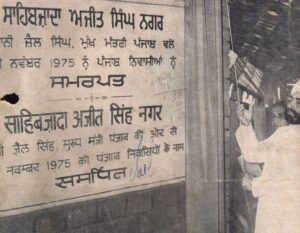
The historic journey began on November 1, 1975, when the then Punjab Chief Minister Giani Zail Singh laid the foundation stone of SAS Nagar near Kamla Market in Phase I. Conceived as a planned township close to Chandigarh, Mohali was envisioned as a modern urban centre that would support Punjab’s growing residential and economic needs.
The Vision Behind Mohali’s Establishment
Following the reorganisation of Punjab in 1966 and Chandigarh becoming a Union Territory, the need for a major planned urban centre within Punjab, close to Chandigarh, became increasingly important. The development of the Mohali area as an industrial estate had been conceived earlier, with the vision eventually expanding into a township combining residential, industrial and commercial facilities.
The city was named Sahibzada Ajit Singh Nagar in honour of Sahibzada Ajit Singh Ji, the eldest son of Sri Guru Gobind Singh Ji. Although its official name is SAS Nagar, it continues to be popularly known as Mohali.
Its early development followed a planned pattern, with residential phases, markets, roads, parks, industrial units and public facilities forming the foundation of the emerging city.
Industrial Growth Shaped Its Early Identity
During its formative years, Mohali established itself as an important industrial destination in Punjab. Public and private sector enterprises contributed to its economic development, generating employment and attracting skilled workers, entrepreneurs and professionals.
Industrial establishments such as Punjab Communications (PUNCOM), Punjab Wireless Systems (PUNWIRE), Punjab Tractors, Punjab Cables, JCT and Philips contributed to the city’s industrial identity.
The expansion of manufacturing and related businesses encouraged residential growth, commercial activity and the development of surrounding areas. Over time, Mohali began emerging as an increasingly important economic centre in the region.
From a Planned Township to a Modern Urban Centre
As the population grew, Mohali expanded beyond its original planned phases. New residential sectors, housing societies, commercial complexes, educational institutions and healthcare facilities transformed its urban landscape.
The development of additional phases and institutional areas created new opportunities for residents and businesses. Markets, schools, colleges, hospitals and recreational facilities further strengthened the city’s position as a preferred destination for living and investment.
Today, Mohali includes established residential neighbourhoods, industrial areas, institutional centres and rapidly developing zones such as Aerocity and IT City.
A Growing Hub for IT, Education and Healthcare
Over the decades, Mohali diversified beyond traditional manufacturing and developed into an important centre for information technology, scientific research, higher education and healthcare.
Institutions such as the Indian School of Business (ISB), the National Institute of Pharmaceutical Education and Research (NIPER) and the Indian Institute of Science Education and Research (IISER) have enhanced the city’s academic and research profile.
IT companies, corporate offices, research facilities and advanced healthcare institutions have created employment opportunities and attracted investment. Improved road connectivity and the international airport serving the Chandigarh region have further strengthened Mohali’s importance as a business and investment destination.
The Punjab Cricket Association’s international cricket stadium has also brought the city national and international recognition in the sporting arena.
Mohali Becomes Punjab’s 18th District
Another significant milestone came on April 14, 2006, when Sahibzada Ajit Singh Nagar was established as Punjab’s 18th district, with Mohali as its headquarters.
The district was formed by incorporating areas from the erstwhile Ropar and Patiala districts, strengthening the region’s administrative importance and bringing government institutions closer to residents.
Today, the district includes important urban centres such as Mohali, Kharar, Zirakpur, Dera Bassi and Kurali. Along with Chandigarh and Panchkula, Mohali forms an integral part of the Chandigarh Tricity region.
The Missing Foundation Stone: A Forgotten Piece of History
Despite its remarkable development, Mohali faces an important question concerning the preservation of its historical heritage. The original foundation stone laid by Giani Zail Singh near Kamla Market in Phase I is reportedly missing from its original location.
The issue received renewed attention around the city’s 50th anniversary in November 2025. A report published by The Tribune highlighted the account of local resident Baljit Singh Papneja, who had painted and inscribed the original stone and retained a photograph of the foundation-stone-laying ceremony. The report also raised concerns about the absence of official records relating to the historic landmark.
The reported disappearance of the foundation stone has brought heritage preservation into focus. The Punjab Government, GMADA, Municipal Corporation and District Administration need to examine the matter, establish the original location and take appropriate steps to preserve the site.
A permanent commemorative structure displaying the city’s founding history, photographs and relevant details could help ensure that future generations remain connected to Mohali’s origins.
There is also a strong case for officially observing November 1 as Mohali Foundation Day every year to celebrate the city’s establishment and recognise its remarkable journey.
Balancing Future Development with Heritage Preservation
As Mohali continues to grow, it faces several urban challenges, including traffic congestion, parking shortages, drainage, waste management, public transport, environmental protection and the need for improved civic infrastructure.
Addressing these issues will require sustainable urban planning, better public amenities and coordinated efforts by the relevant authorities.
At the same time, preserving historical landmarks must remain an important part of the city’s development agenda. Progress should not come at the cost of losing the memories and milestones that shaped Mohali.
Mohali’s journey from a developing township to a modern urban destination represents decades of vision, enterprise and collective effort. The foundation stone laid on November 1, 1975, marked the beginning of that journey.
A city that takes pride in its achievements must also remember its beginnings. Mohali’s future may be modern, but its roots remain connected to the historic day when Giani Zail Singh laid the foundation of Sahibzada Ajit Singh Nagar.