
NEW DELHI :
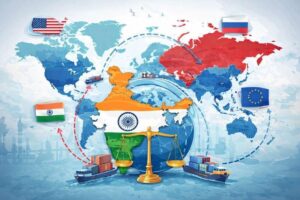
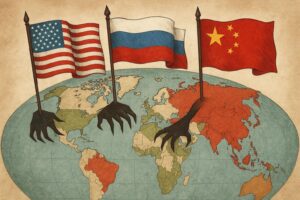
The world may be approaching a defining moment in international politics. The possibility of the leaders of three powerful nations—the United States, Russia and China—coming together on a common diplomatic platform has sparked speculation about a possible transformation in global power equations.
If US President Donald Trump, Russian President Vladimir Putin and Chinese President Xi Jinping engage in meaningful high-level dialogue, the implications could extend far beyond the conference table, potentially reshaping international diplomacy, economic partnerships and the global security architecture.
This is not merely about three leaders meeting. It is about three competing centres of power exploring whether their differences can be managed, their interests reconciled and a new understanding of global affairs established.
But the most important question remains: Will this convergence bring greater stability to the world, or will it pave the way for a new arrangement in which powerful nations determine the future of others?
NUCLEAR DISARMAMENT OR A NEW GLOBAL POWER EQUATION?
One of the most significant issues that could dominate any such engagement is the growing concern over nuclear weapons, strategic competition and global security.
With the United States, Russia and China possessing enormous military capabilities, their willingness to engage in meaningful dialogue could create an opportunity to reduce tensions, control the nuclear arms race and prevent a dangerous escalation.
However, diplomatic history offers a more complicated lesson. Major powers rarely negotiate without considering their strategic advantages. Agreements that appear to promote peace can also serve to protect national interests, establish spheres of influence and redefine the rules of international engagement.
The world must therefore look beyond diplomatic photographs and carefully examine the substance of any understanding reached between these countries.
SMALLER NATIONS: THE UNSEEN CASUALTIES OF BIG-POWER DIPLOMACY
Perhaps the greatest uncertainty concerns the future of smaller nations and emerging economies.
If the world’s three most influential powers reach a common understanding on major geopolitical issues, countries with limited military and economic strength could face increasing pressure to align their policies with the preferences of powerful nations.
An African proverb captures this reality perfectly:
“When elephants fight, it is the grass that suffers. When elephants make peace, the grass suffers too.”
The message is profound. Whether superpowers confront one another or negotiate a settlement, smaller nations can find themselves paying the price. Their sovereignty, economic interests and independent foreign policies may become vulnerable to decisions taken far beyond their borders.
The emerging question is whether global diplomacy will continue to respect the principles of sovereign equality or gradually move towards a system dominated by a handful of powerful nations.
INDIA’S BIGGEST DIPLOMATIC TEST
For India, the possible convergence of Washington, Moscow and Beijing carries particularly significant implications.
New Delhi has consistently followed a policy of strategic autonomy, maintaining relationships with competing global powers while refusing to compromise on its core national interests.
India’s relationship with the United States has expanded significantly in defence, technology, trade and strategic cooperation. At the same time, Russia remains an important defence partner, while China continues to be a major economic player and a source of serious security concerns along the border.
This delicate diplomatic balance could face fresh challenges if the three powers begin coordinating their positions on major international issues.
President Donald Trump’s transactional approach to diplomacy, particularly on tariffs, trade negotiations and economic interests, adds another dimension to the situation.
Any improvement in Washington’s relations with Moscow or Beijing could potentially alter the strategic calculations surrounding India.
However, it would be premature to assume that the United States could simply use Russia or China as instruments to put pressure on New Delhi. Each country has its own national interests, strategic priorities and long-term ambitions.
COULD CHINA-PAKISTAN TIES BECOME A GREATER CONCERN?
India’s concerns are not limited to Washington and Moscow. China’s strategic partnership with Pakistan remains a significant factor in South Asian security.
Any major shift in the relationship between the United States and China could influence the regional balance of power, trade arrangements and diplomatic equations.
India will have to closely monitor whether such developments affect its security interests, particularly in the Indo-Pacific region and along its northern borders.
At the same time, India must avoid viewing every diplomatic understanding between major powers as a direct threat. Its response must be guided by strategic assessment rather than speculation.
INDIA MUST STRENGTHEN ITS OWN POSITION
The answer to emerging geopolitical challenges lies not in joining another power bloc but in strengthening India’s own capabilities.
New Delhi must continue to focus on:
- Defence self-reliance: Strengthening indigenous defence manufacturing and reducing excessive dependence on external suppliers.
- Technological advancement: Investing in artificial intelligence, semiconductors, space technology and emerging industries.
- Energy security: Diversifying energy sources and protecting long-term national interests.
- Economic strength: Expanding manufacturing, exports and international trade partnerships.
- Diplomatic independence: Maintaining constructive relations with all major powers without becoming dependent on any single country.
India’s growing economic strength, strategic location, international standing and role in the Indo-Pacific provide it with considerable leverage.
The challenge is to convert these advantages into lasting diplomatic influence.
A NEW WORLD ORDER OR ANOTHER GAME OF GLOBAL POWER?
The possible coming together of Donald Trump, Vladimir Putin and Xi Jinping raises a fundamental question about the future of international politics.
Are the world’s biggest powers preparing to resolve their differences, or are they negotiating the terms of a new global balance in which their own interests take priority?
For India, the challenge will be to ensure that no international understanding compromises its sovereignty, security or independent foreign policy.
Will the three superpowers reshape the world to suit their interests, leaving other nations with fewer choices? Or will India demonstrate that a confident and rising nation can protect its interests through diplomatic wisdom, economic strength and strategic independence?
The coming months and years could prove decisive.
India does not need to choose between superpowers. It needs to become strong enough that every superpower recognises the importance of India’s partnership.
Because in the emerging world order, the real test of a nation’s influence will not be whom it stands beside, but how firmly it can stand on its own.
— Deshraj Kaundal